
Essay 6: The Boat That Came Second
This is a story about a rowing race, but it’s also about how capacity moves through a system. Sometimes a blue zone forms for a moment, and from the outside it can look like discipline, talent or success. What we’re often seeing is the web at work.
The Architecture of Wellbeing Series
This is a story about a rowing race, but it’s also about how capacity behaves inside a group system. The quickest way to describe what happened is two words: Cool Runnings. It is about 90% true. The remaining 10% is artistic licence to protect the privacy of those involved.
Five kids put their hands up for rowing, which meant five kids were in the boat.
Go to any major river in any Australian city and you will see the private school crews on the water. Rowing is, by and large, a rich kid sport. A school with the budget for a handful of $30,000 boats is the entry point. Some programs have families who donate that figure season after season to see their name on the hull. Those schools have ample boats to train ample bodies. Some kids join a rowing program and their parents buy an ergo for the home gym.
None of these kids were short on opportunity. They had access to a sport that exists because schools and families can afford it. But even within that world there is a hierarchy of resources: programs with deep benches and multiple boats, and those one learning mistake away from forfeiting several races.
This program sat closer to the latter.
The pool of interested kids was much smaller than their competition. A rumour circulated that the other schools stacked their crews for better results. Although that was probably folklore, I must say a few of those children looked like they could grow a moustache better than my dad in the 70s.
Loads of kids had turned up for the come and try day, but once word got around that there would be 5am starts down the track, children and parents alike quietly pulled the pin. The more naturally talented athletes drifted back to basketball, volleyball or another tall kids sport that kept reasonable hours. Honestly, fair. Expecting growing teenage boys to get up that early is asking for a boulder with BO to be pushed up a hill.
What was left wasn’t the ideal five, but it was the five whose conditions allowed them to stay. Fortunately you only need five kids for a boat to race - four rowers and a cox - so the program went ahead.
One of those kids was navigating a health challenge that hadn’t been properly understood yet. He didn’t want to be there and his parents had encouraged him to give it a go for the full season before quitting. The fact that he had shown up week after week was itself an act of quiet courage. Not a discipline problem. A conditions problem.
Another was close to six foot tall by his thirteenth birthday. When your body is changing that fast it’s almost impossible to get good at any sport. His hand-eye coordination, temporarily outpaced by his own skeleton, meant he moved like a newborn giraffe on the side of a hill. Still, someone with a trained eye looked at this kid and thought: put that coat hanger in a boat. The architecture pointed toward what would arrive two or three years from now - long levers that would eventually become an advantage, even if his knees were the widest part of his legs now.
At home he had a sibling who seemed to win everything. Success that showed up while they still had toddler forearm rolls. A bedroom full of squishmallows covered in blue ribbons offered the kind of visible proof of sporting success our lanky teen was yet to earn. His introduction to rowing had not been glamorous. The year prior he had served as the Year 7 call-up for another sparse crew. Dropped into the boat to get enough bums on seats, it was a baptism of fire. Those kids lost their race by nearly two minutes, delaying even the race scheduled after them. When they finally crossed the finish line, the child sitting behind him vomited straight down his back.
Still, he came back the next season so the coach gave him a nickname: Big Chief.
A kind and gentle kid with very long legs was our third. He had been a strong rower the previous term but broke his arm in the school holidays. He kept showing up to training anyway, which was a season-saving move in itself. Since numbers were short, Broken Arm had no choice but to swap places with the coxswain. The tiny outgoing Energiser Bunny who had been coxing - perfectly suited to the role - now had to sit on a floatie lift to fit in the boat. Despite not having trained a single ergo, Energiser Bunny was a regular at run club and had absorbed some technique as a cox, so could keep up surprisingly well.
Broken Arm was genuinely scared of steering the crew wrong and taking them into the reeds. Before each race he could be seen with his Dad privately rehearsing the encouragement he would call out to the rest of the crew. He practised being loud enough for them to hear. His presence made the boat easy to spot: a great dane puppy squeezed into a space designed for a chihuahua. Headset on. Steering with his good arm. The other in a black cast draped across his knees which themselves folded up to his chin.
Our fifth kid, reliable and technically minded, came from a family infrastructure that meant he would be at those regattas regardless, because his older sister was a rower. He wasn’t the tallest or fastest, but he seemed to know everyone and his steady presence had been part of what kept the rest from pulling out when the 5am starts loomed. He was the Social Glue, and his motto seemed to be: if I’m at the regattas, I may as well be in the boat.
And this group were in the boat.
Week after week they slogged it out to no avail. At least, that’s how it looked at the time.
Watching your children build resilience is harder than people like to admit. We tell ourselves we put our kids in sport for the teamwork, the fresh air, the movement, the discipline. All the things we tick on the permission slip. What we don't write on that form is: I also want my child to feel like a winner sometimes. And every single Saturday, these kids lost. Badly.
As a spectator you stand along the riverbank trying to work out which boat belongs to your child. What time is it? Has their race started? Which boat is theirs - can you see it? What colour hats are they wearing?
Ah. There they are. That boat.
The one coming last by half the river.
These boys knew exactly where they sat in the pack, teenagers are hyper aware of social signals. They had slumped shoulders after each race. Other crews celebrated finishes thirty or forty seconds ahead of theirs. Through this massive losing streak their young coach really held down the fort. Never looking at the other boats, he was relentlessly growth-oriented and steered them back to their own race.
“That was the most cohesive I’ve seen you row. Next, I want you to match that and aim to shave ten seconds off your time. You’ve got it in you.”
Trouble struck the night before the second-last Saturday of the season. The boy with health challenges was seriously unwell and would not be returning to rowing - or any sport for that matter - for a while. Doctors had finally found the problem, and the advice was that he shouldn’t be walking on flat ground at the moment, let alone hitting 180 BPM on the water.
These lads had scraped through nearly an entire season with exactly the minimum number of kids required. They had one more Saturday race before the big one, the Head of the River, and it looked like they would have to forfeit due to numbers, it was rotten luck. So a Hail Mary message went out to the parents’ WhatsApp group asking if anyone knew of a younger kid who could step in. The answer came quickly.
Enter the Dynamo.
A wiry Year 7, not technically old enough to compete yet. His “yes” was halfway out of his mouth before the question had even finished being asked. In most rowing programs an underage call up looks like a kid being chucked into a seat - or chucked on, as was the case for Big Chief the year prior - to fill the numbers. Expectations tend to be low because the skill, the confidence and the size just aren’t there. But this kid was feral for it. Too small for the boat. Too young for the race. But completely certain rowing was his sport, grinding out ergos and watching YouTube technique videos because he loved it. Something in him had decided: game on, moles.
He grabbed that seat like a golden ticket, and the next day they raced for the first time as a team.
Six boats on the water. All season, one of them had been coming last by enormous margins. The last minute crew change was expected to make that gap even worse. While we waited on the bank the usual pack came through. We squinted toward the distant back looking for our boys, eyes searching for the crammed knees and the black cast. Our hearts sank. They weren’t there.
Oh no, we thought. Something must have gone wrong. A false start perhaps, or the dreaded steering into the reeds. Then the knees were spotted, but they were not way out back.
Broken Arm was steering their boat in the bloody pack.
Big Chief, who couldn’t see much without his glasses, was just rowing - but geez his form looked strong. The rest of the crew kept pace beautifully, two kids now on floatie lifts in the middle engine, moving like one organism. The system had clicked. Their coach hustled down to the water’s edge to see closer to the finish line. This time they definitely didn’t come last. They came second out of six, shaving more than a minute off their best time, ever.
The unanswerable question is: what made the difference that day?
Was it the Dynamo’s tenacity? Broken Arm learning to cox? Big Chief slowly growing into his body? The Social Glue’s technical steadiness? The Energiser Bunny’s cardiovascular grit? Their coach’s philosophy?
The answer is yes. All of it. And none of it.
For the length of one race, a capacity blue zone existed.
I can’t recall who won the race that day. It was probably the same crew who always did. But I will never forget the sight of those five second placers walking up the sandy riverbank carrying their boat, shoulders back. Two with floatie lifts shoved down the front of their zoot suits, looking like underfed pigeons. Broken Arm in his black cast, smiling shyly, and the rest grinning ear to ear as they walked through the crowd to a standing ovation that Big Chief could hear but not properly see because his glasses were in his sports bag.
Epilogue:
The season continued. At the Head of the River they lined up again, this time in matching Spider-Man socks their coach had bought in a quick dash to Target the night before. They didn't win a single race that season, but they did receive an award in the end: Most Improved. As it was handed out to a room full of clapping families, Big Chief's sibling was heard to say: "Oh good, he finally won something."
Next season you can go down to the River Torrens and see Big Chief happily yapping away to his mates having found a sport that fits him. Social Glue may have lured a few more kids into the program. Broken Arm will be back rowing in the boat once his cast is off, and a mid-year growth spurt or two could mean fewer floatie lifts in their boat.

Essay 5: The Architecture of Wellbeing Framework
This is the framework essay for the Architecture of Wellbeing.
The Architecture of Wellbeing Series
The previous essays in this series explored the hidden infrastructure shaping wellbeing: invisible labour, the conditions that support discipline, and the patterns that emerge when capacity aligns. At times the ideas may have appeared to jump around. From spiders on drugs to Facebook comment sections, they were all pointing to the same thing. What follows is the framework that emerged from those observations.
This framework, which I am calling the Architecture of Wellbeing (AoW), came from a fifteen-year process of looking for the threads. What connects one wellbeing outcome to another? How do you reveal the structure underneath so you can understand what actually went right or wrong? Over time, those threads began to converge into a pattern.
The insight arrived during my own version of a capacity earthquake. Job loss, relationship distress, parenting challenges and a never-ending pile of washing. Being suddenly unemployed meant I had the time to go to therapy but not the funds. What I did have, for the first time in a decade, was proximity to family. Returning to live in the same city as my village, I saw Adelaide with fresh eyes — no longer somewhere to escape from quickly, the way it can look to a younger person seeking excitement. Trying to make a balance sheet of present parenting, managing a household, working and still being well was a budget I could not seem to make add up. Now, with cousins down the road and parents who could step in, the capacity factors I had lacked for a decade suddenly had a name.
Before this I had constantly wondered: how on earth was this supposed to all fit? What I could now see was that it had already been at capacity. There was grief in that realisation. I had been playing life on hard mode and interpreting the strain as a personal failing.
Zooming out - and in group chats with girlfriends - we were knee-deep in unpacking invisible labour, perimenopause brain fog, mental load, moody teenagers and insomnia. Everything seemed connected. I suppose I was the right person to notice it.
Struggling with burnout and fighting to rebalance my own web, picking apart what worked and what didn't, a system began to emerge. What started as an attempt to understand my own circumstances gradually became a broader framework for understanding how wellbeing emerges from the structure of everyday life.
The Architecture of Wellbeing describes how key domains of daily life interact to shape the capacity available to individuals, households and communities to engage in ways that are well. To care for ourselves, to show up for the people around us, and to build good lives. It shows why healthy behaviours feel natural when capacity exists and like a luxury when it doesn't. It also reveals that the traits we admire - discipline, consistency, self-control - are often reflections of underlying capacity rather than pure character.
The truth usually lives somewhere between two explanations. Nature or nurture? Both. Individual choice or structural conditions? Also both. Most wellbeing conversations focus on the pillars of health: sleep, nutrition, movement, stress regulation and connection. Cultural narratives often attribute these outcomes to personal traits - discipline, focus, better priorities. These behaviours matter enormously, but they are not the full story. They occur within a deeper underlying structure.
A model that recognises both human agency and the infrastructure that shapes it is the most honest framework I know how to build. Life is rarely one thing or the other. The Architecture of Wellbeing is my attempt to describe that system.
Why Pillars Don't Stand Alone
As a naturopath with Western herbal medicine and yoga teacher training also up my sleeve, I have spent a long time working with the traditional wellbeing pillars. Lifestyle has always been central to my philosophy of what makes a well life.
I have also worked in supplement marketing and product development, which means I have seen the industry side of those pillars too - time spent dissecting and stacking them, chasing the "one thing" that makes the difference. The unicorn lever. The hero ingredient that unlocks everything else, packages up cleanly and ships well. Gut health powders. Detox programs. Insulin resistance nutraceuticals. The food pyramid updated for the modern consumer.
It is genuinely tempting. The hope that somewhere there is a single behaviour, product or intervention that will change everything is not an irrational one. It is a very human one.
But after fifteen years of looking, the reality seemed both simpler and harder than any of those explanations. All the pillars matter. Sleep matters. Nutrition matters. Movement and stress regulation and connection matter too. What became clear, however, is that these pillars do not stand on their own. They exist within a wider structure that determines how easy or difficult they are to sustain in everyday life.
The Architecture of Wellbeing attempts to describe that structure.
The Web of Capacity
When I first started developing this model, I imagined capacity as a scale — something that could tip toward overwhelm or ease depending on the pressures applied. Over time that idea evolved. Capacity does not sit on a single scale at all. It operates across multiple domains at once.
Life is not linear, and I found myself thinking about the repeated structures that appear in nature: the honeybee's hexagon, Fibonacci's shell spiral, the geometries that allow complex systems to distribute load and remain stable. Of these, the spider's web stayed with me most.
It turns out spiders - while also being nightmare fuel - are quite good systems engineers.
A spider's web distributes tension across many anchor points. Pull in one place and the pressure travels through the entire structure. It is both flexible and sensitive. Wellbeing is very much like this. Less like a stack of pillars and more like a network of interacting capacity domains.
Figure 1 shows a simplified version of this capacity web.
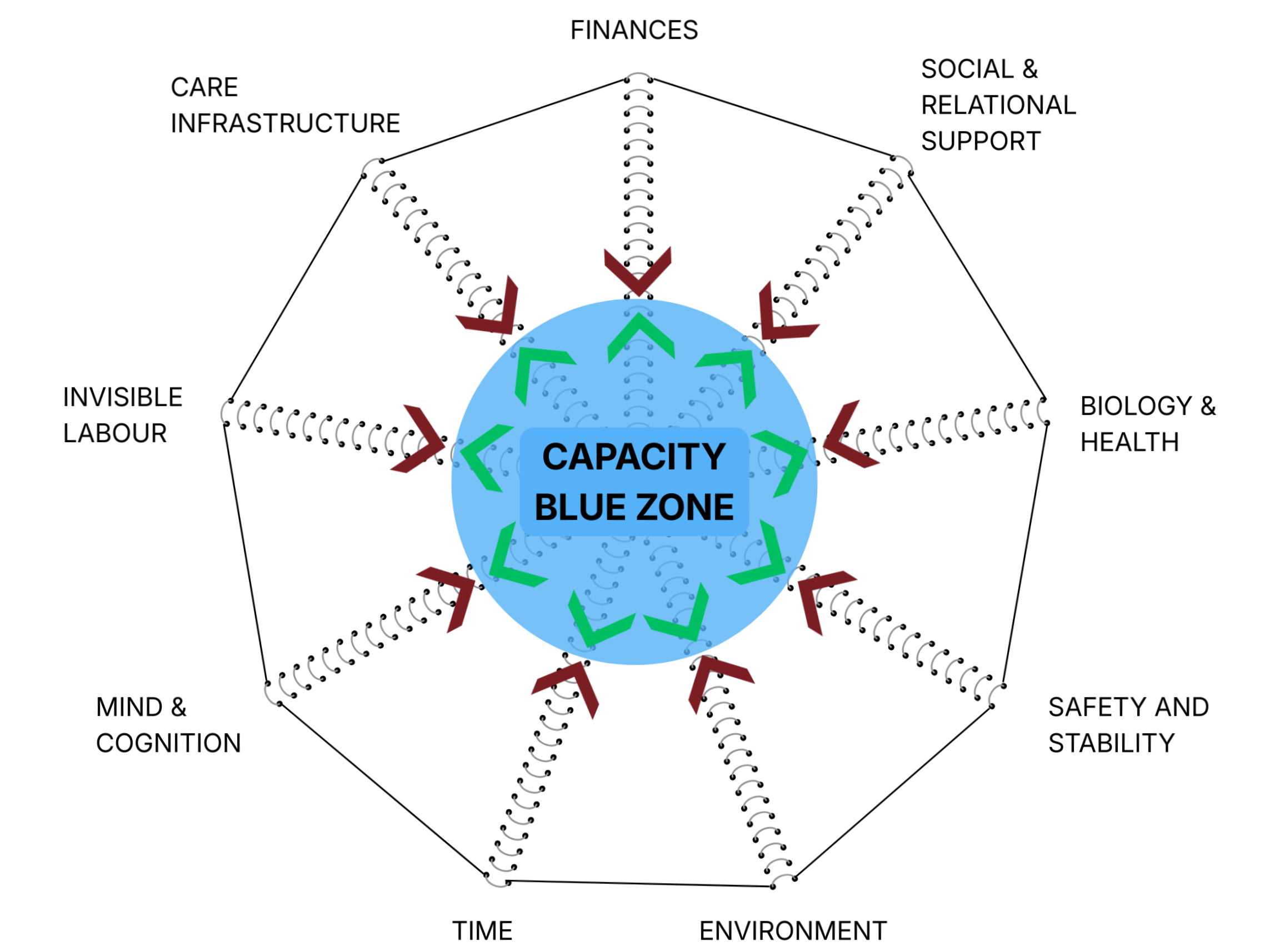
Figure 1: The Web of Capacity.
Visualised as a web, with the individual at the centre, these domains act as anchor points distributing tension across daily life. When conditions shift in one area, pressure redistributes across the rest of the system. Seen this way, balance rarely depends on one heroic change. There are often many small adjustments across the web that can restore stability.
Each thread and node contributes to where a person finds themselves within the structure.
The Capacity Nodes
The Architecture of Wellbeing identifies nine core capacity nodes. Together these nodes form the structural conditions that shape available capacity. Not isolated like pillars - these domains operate more like threads within a web. When tension changes in one part of the AoW system, pressure redistributes across the rest.
Conditions can vary widely throughout life. More money can buy time, or constrain it, depending on how it was earned and what responsibilities come with it. A supportive partner may stabilise several nodes at once, while sudden illness or caregiving can strain the entire structure. Within this system no single node controls the outcome, nor should it. The web is interactive and dynamic - both robust and sensitive to change.
Table 1 shows the capacity nodes and what each represents.
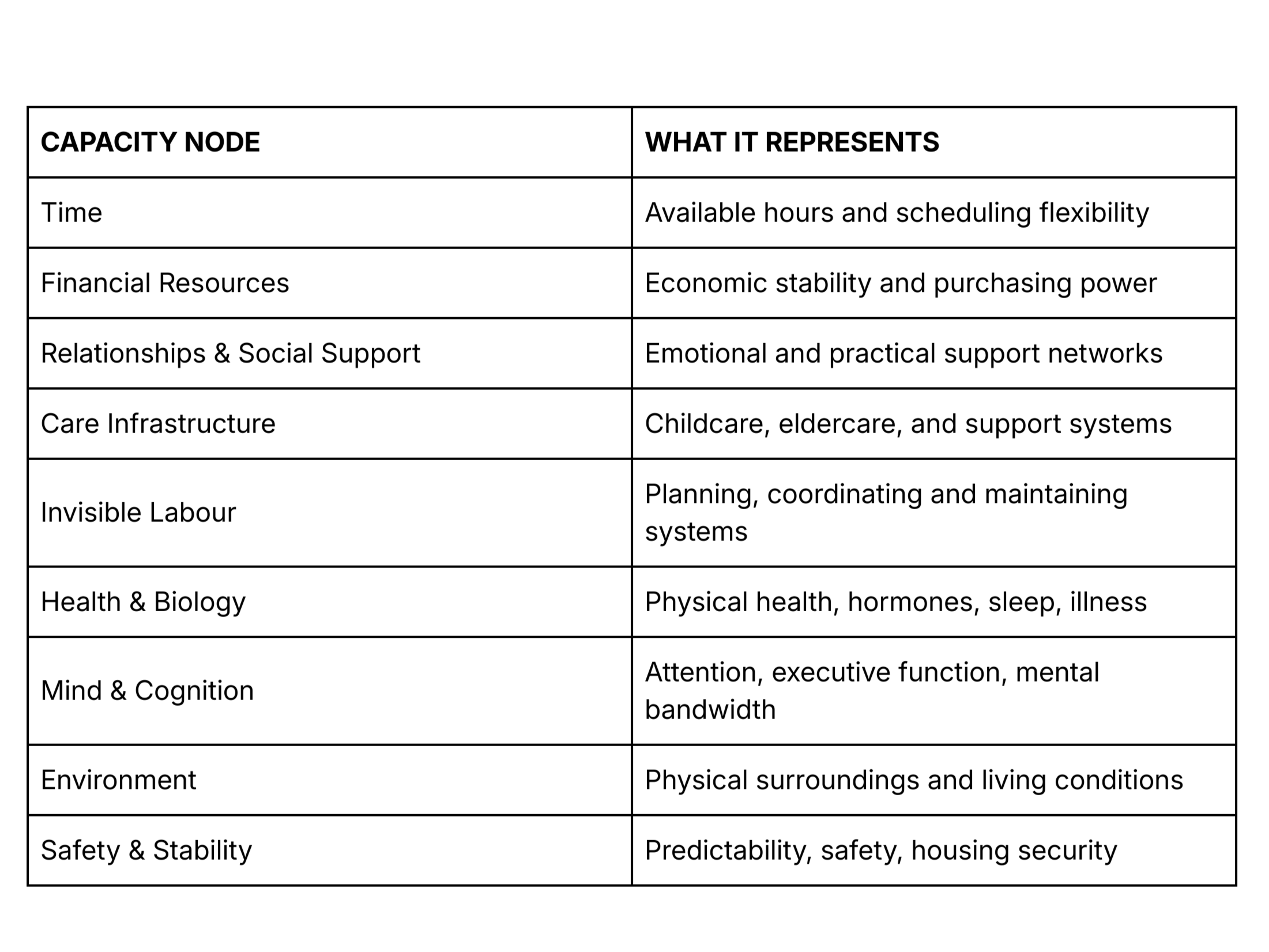
Table 1: The Capacity Nodes
Together these nodes describe the internal architecture of a capacity web. But no web exists in isolation. The conditions shaping each node are also influenced by wider forces operating across societies and communities - shaping how much capacity individuals and households are able to build in the first place.
Transverse Forces
I have always been interested in public health and the ways large systems shape the wellbeing of entire populations. The contrast between countries can be striking. In Finland, for example, every new parent receives a government-provided maternity package - commonly known as the Finnish "baby box" - containing essential items for a newborn and designed to support early child health and safety. Policies such as universal healthcare, parental leave and early childhood support systems can influence the wellbeing of millions of people at once.
At the other end of the spectrum, the absence of universal healthcare, or practices that directly harm bodily autonomy in some parts of the world, demonstrate how policy, culture and power structures can dramatically shape health outcomes.
These examples illustrate a simple point: wellbeing does not emerge only from individual behaviour. No web exists in isolation. The conditions shaping each node are influenced by wider forces still - operating across societies and communities, shaping how much capacity individuals and households are able to build in the first place.
These forces do not belong to any single node. They cut across the web itself, subtly changing the tension of multiple nodes at once. Below is a summary of some ways these forces interact with the nodes.
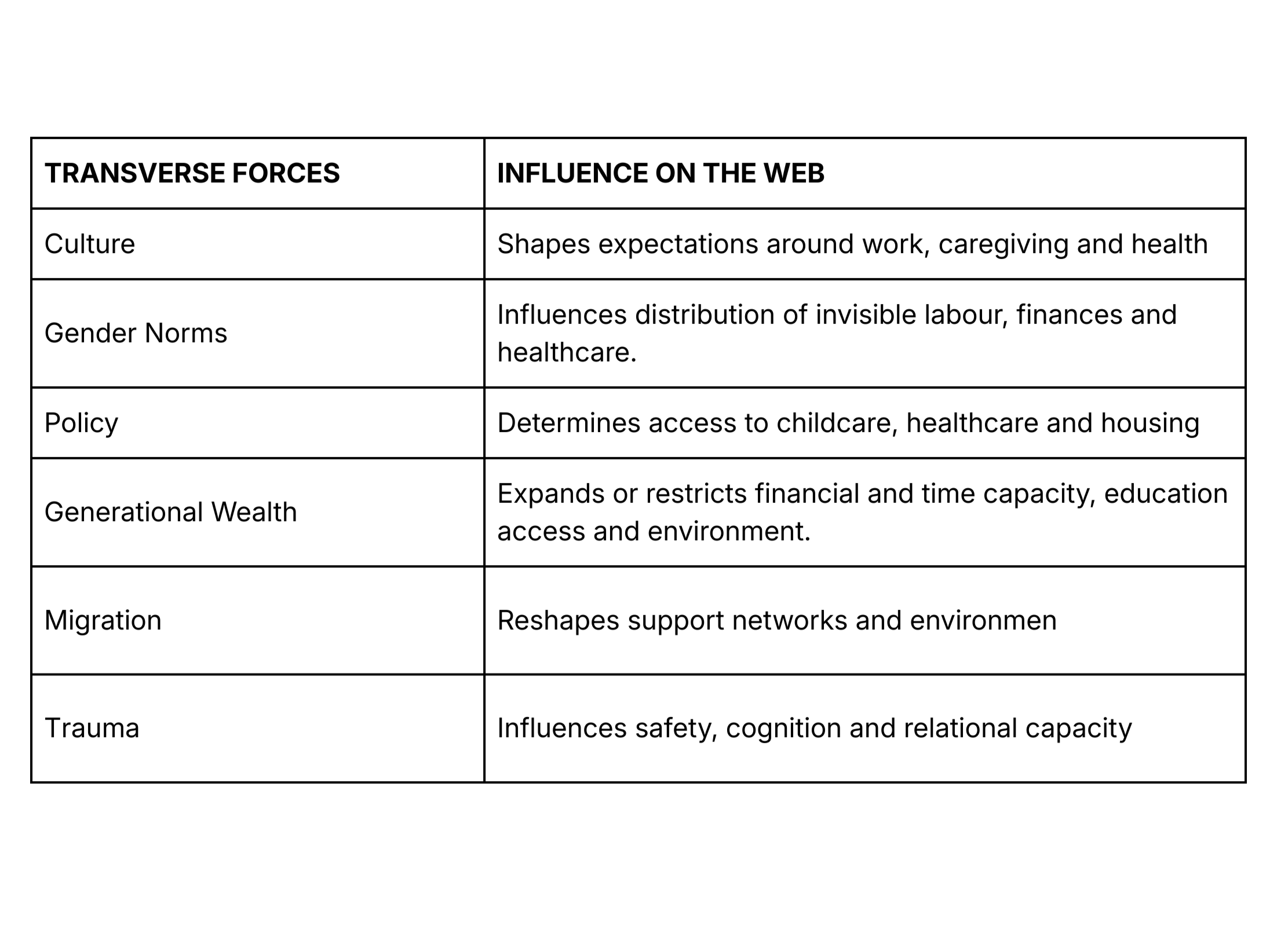
Table 2: Transverse Forces on the Web
You can change your habits. You cannot, alone, change your culture, your policy environment or the generational architecture you inherited. This is why the transverse forces matter.
Structural Principles of the Web
As nodes and transverse forces interact over time, patterns begin to appear in how systems stabilise, stretch or break down. Several structural principles became visible through this process - consistent enough across individuals, households and organisations to suggest they describe something real about the way capacity moves.
The Load Distribution Principle.
Systems remain stable when pressure can move across multiple nodes. They become fragile when load concentrates in one place — or around one person — for extended periods. Sustainable systems distribute stabilising responsibility rather than concentrating it.
The Elastic Capacity Principle.
Human systems are remarkably resilient, but their capacity is elastic rather than infinite. People can temporarily extend their available time, energy and emotional bandwidth to navigate demanding periods. New parents, caregivers and people managing crisis often operate in this extended state for months or even years. Eventually, elasticity has limits. When pressure accumulates across multiple nodes at once, the web weakens
The Behavioural Loop Principle.
Health behaviours function as both inputs and outputs within the system. A regular walk improves sleep, which improves cognitive bandwidth, which makes the next walk more likely. The reverse is equally true. Behaviours either reinforce the stability of the web or gradually destabilise it.
The System Scale Principle.
Capacity webs operate across individuals, households, workplaces and communities. The nodes look different at each level, but the underlying mechanics remain consistent. This is why the health of an ageing parent, or the income a partner contributes, ripples into the wellbeing of the wider system. The web does not disappear as systems grow. It simply becomes larger.
The Stabilisation Principle.
Systems tend to stabilise around individuals or nodes that repeatedly absorb pressure. These people function as system sentries — quietly monitoring tension and disproportionately called upon when pressure events arise. While this stabilising role can temporarily protect the system, prolonged concentration of load weakens the resilience of the web for everyone in it.
The Web at Different Scales
Although the AoW is easiest to picture at the level of an individual life, the same structural mechanics appear again and again at larger scales.
An overwhelmed parent, an overstretched business founder and a healthcare system in pandemic may appear to be entirely different problems. Viewed through the Architecture of Wellbeing, however, they reveal the same underlying mechanics of load distribution, capacity and stabilisation.
The web does not disappear as systems grow. It simply becomes larger.
Capacity Transfer
Because pressure redistributes across the web, strain rarely remains confined to one node or one person.
I think of this movement as capacity transfer. Within any web, when one node carries less load, the overall pressure does not disappear. Like energy, it shifts somewhere else. Time, money, caregiving, emotional labour and cognitive bandwidth constantly move through the structure seeking balance. The great Australian midweek dinner of a hot chook and a bag of coleslaw is one perfect example of that energy redistribution.
Energy cannot be created or destroyed - it can only be transferred. In a capacity web, the same is true.
Within households, this often appears as one person absorbing additional responsibility so another can recover from illness, pursue a career opportunity, or simply have an evening that belongs to them. Each time I head up Mt Lofty for a hike with friends, or my partner goes to Victoria Park for a run, the caregiving and invisible labour either piles up or transfers to someone else.
When capacity transfer is reliable and reciprocal, it expands what becomes possible in a week. Deferring tasks to squeeze more in usually doesn’t. The problems that never happened, the overwhelm that didn’t pile up. That’s capacity transfer at work.
Children require immense capacity transfer. The village surrounding a household is often the most stable and reciprocal source of it. When my niece had her netball final and the team agreed on matching braided hair, I received a single-breath text: “Auntie Jenny are you home I need you to braid my hair what time can you pick me up”.
I am the local fishtail-braid aficionado.
I was there in ten minutes.
When capacity transfer is visible and shared, systems can remain stable even during demanding periods. When it becomes chronically invisible or one-sided, pressure begins to concentrate around particular nodes and particular people. Negative feedback loops emerge. Over time, this can destabilise the web even when the surface of a life appears to be functioning smoothly.
People often believe they are observing discipline, motivation or personal failure, when what they are actually watching is the movement of capacity through a web.
From that misreading, a number of common fallacies in wellbeing thinking begin to take hold.
The Fallacies We Tell Ourselves
Several recurring simplified explanations appear when the Architecture of Wellbeing is not visible. These fallacies show up repeatedly in how wellbeing is commonly discussed - in health culture, in workplaces, and in the stories people tell about themselves.
The Discipline Fallacy.
The most common assumption in modern health culture is that successful people simply have more discipline. She gets up at 5am and trains before her family wakes up. He's been consistent for years. Must be discipline.
Within the Architecture of Wellbeing, discipline is an output. It reflects supportive infrastructure and available capacity as much as it reflects character. Stable systems allow habits to flourish. Strained systems make them fragile. This does not mean behaviour does not matter. It means behaviour does not occur in isolation.
The Individual Control Fallacy.
Wellbeing advice often assumes individuals have equal control over the conditions of their lives. In reality, many structural factors sit outside individual control: housing stability, policy environments, cultural expectations, family structure, caregiving responsibilities, economic conditions. Two people may attempt the same behavioural change while operating inside very different structural architectures. The outcomes will rarely be the same, and the difference is not character.
The Pillars in Isolation Fallacy.
Health conversations tend to focus on one factor at a time. Sleep. Nutrition. Exercise. Stress. While these domains matter enormously, treating them in isolation ignores the interconnected nature of the web. Pressure rarely remains confined to a single node. When a pillar falls — when the exercise routine collapses, the sleep deteriorates, the healthy eating disappears — that failure is rarely about the pillar itself. It is a symptom. The structural conditions surrounding it are under stress, and the pillar is simply the most visible thing to go. Even the gut health powder is a bandaid for the symptom.
The Visibility Fallacy.
Many of the most powerful influences on wellbeing remain invisible. Invisible labour, caregiving logistics, social support, environmental design and financial security quietly shape the capacity available to an individual or household. Because these forces operate in the background, attributing outcomes solely to personal choice becomes misleading. Capacity is often paid for by someone else. Once the web becomes visible, many of these assumptions begin to dissolve.
The Optimisation Fallacy.
Wellbeing discourse loves to optimise small behaviours while overlooking the far larger structural differences in conditions from person to person. Biohacks, supplements and productivity systems tend to target the final ten percent of potential improvement. Using the AoW framework, we see that most outcomes are shaped by the underlying ninety percent: time capacity, caregiving load, financial stability, social support, environment and structural safety. When the underlying architecture of a life is unstable, attempts to optimise small behaviours rarely produce lasting change. Structural stability matters more than marginal optimisation.
What State is Your Web In?
While many factors can influence the web, its overall condition at any given moment can usually be understood through four system states.
Capacity Stretch is gradual strain building across one or more nodes - insidious by nature. Think of a lobster in water that is slowly brought to the boil. The challenge is not the temperature at any single moment. It is the longevity of it. Long working hours, chronic sleep deprivation, caregiving load, or the quiet accumulation of invisible labour can slowly tighten the web over months or years. Depletion without sufficient recovery. Pressure builds and is often normalised. Change is considered long after the structure is already under serious strain. Many people do not realise they have been in a capacity stretch until something small and seemingly manageable finally breaks them.
Capacity Shock is survivable when other nodes are stable enough to absorb it. I once moved house alone with two small children while my husband was away for work. At the time I had a second degree burn that was infected on my arm, rubbing right where the boxes would hit as I carried and stacked them. I was only moving 2 streets away and could carry a washing machine the length of a hallway. I could not carry that washing machine for a year, which is the difference between a capacity shock and a capacity stretch. Shocks are common in everyday life. Most of us move through several a year without naming them as such.
Capacity Earthquake is different. Earthquakes occur when several major pressures arrive at once, or when one life event destabilises multiple nodes simultaneously. The arrival of a new baby, relationship breakdown, bereavement, major illness - these rarely affect just one part of life. They send shockwaves through the entire structure, impacting finances, time, emotional capacity, relationships and physical health all at once. The web must stretch dramatically to absorb the impact, and sometimes nodes detatch, temporarily collapse and must be rebuilt. Many people recognise these seasons immediately. The question is no longer about optimisation. It is about survival. Rest assured though: repair is possible.
Capacity Blue Zone describes a state of relative equilibrium - the gold standard. When supportive conditions align, wellbeing becomes the path of least resistance rather than another task forced into an already crowded life. The web holds its shape with far less effort, adapting with resilience to the flexion and change of a life well lived. This is where the street nonna lives. The one who has never done a Pilates class in her life and is absolutely fine.
Seeing the Web: Toward a Diagnostic Tool
If wellbeing emerges from the architecture of daily life, understanding it requires looking beyond symptoms toward structure.
One of the most significant practical extensions of the AoW framework is a diagnostic tool designed to map the nine capacity nodes across an individual's web. Rather than evaluating personal discipline or behavioural success, this kind of assessment would identify where structural pressure is concentrated — and where recalibration would relieve it most.
Visualising how load is distributed across the system shifts the conversation from "Why can't I keep up?" to "Where is the system carrying too much weight?"
The applications are broader than the individual. The same diagnostic logic applies to couples and households -mapping where capacity transfer is invisible or chronically uneven, and what redistribution might actually look like in practice. It applies to clinical settings, where a practitioner working with burnout, anxiety or chronic illness might use the web to identify structural contributors that sit well outside their typical scope, but are nonetheless driving the presenting condition. It applies to workplaces, where team leaders or HR practitioners could use the framework to identify structural bottlenecks — the system sentries quietly absorbing disproportionate load, the nodes under pressure that no productivity intervention will fix.
In each of these contexts, the purpose is not to produce a score of success or failure. It is to make the invisible visible. To provide a map of a system's current structural position - where the web is stable, where it is stretched, and where recalibration is most likely to produce lasting change.
Over time, a validated assessment tool of this kind could allow researchers to examine patterns of structural wellbeing at scale, in much the same way that psychology currently measures burnout, stress or cognitive load. The individual web, it turns out, has much to tell us about the systems surrounding it.
Once the web becomes visible, many of the stories we tell about discipline, success and failure begin to change.
The Architecture of Wellbeing does not remove the role of personal choice. It simply reveals the structure within which those choices are made. When that structure is stable, healthy behaviours become easier to sustain. When it is strained, survival itself can become the achievement.
Looking back, I can see that the framework only became visible to me because my own web changed. Some nodes weakened dramatically while others strengthened in ways I hadn't expected. That instability made the structure visible. What I had assumed was personal failure began to look more like structural strain.
Once the threads were visible, they could no longer be unseen.

Essay 4: Capacity Blue Zones
Nine nodes, one web, and the reason your nonna isn't doing Pilates. The conditions surrounding a life have a shape. Here's what it looks like.
The Architecture of Wellbeing Series
Whenever I read about Blue Zones I come across the comment "fake! This has been debunked." Which is halfway true. Records in some regions were incomplete, the data contested, and it turned out some cheeky buggers were cashing cheques for relatives who had died.
Still, when researchers applied the findings in other parts of the world, they worked. So how do you debunk something that keeps being true? The idea that we can live in environments that naturally nudge people toward specific lifestyle habits is not revolutionary. Of course eating whole foods, moving naturally and spending time outdoors is good for us. We are creatures on the earth after all. We’re not above the basics.
The Blue Zone image most people carry is something like this: piercingly clear eyes smiling out of origami aged skin. The ancient nonna inexplicably chaffing a cig in the cobbled street. You think: what is going on here? The version closer to home is overworked, under fuelled and running late. Yoga mat under one arm. Double cap in the other. The one trying hardest to be well is not the one who is.
Given the right conditions, most of us would arrive at something closer to the street nonna than the double cap and yoga mat without trying nearly as hard. Bodies tend to seek equilibrium. The problem is that the conditions surrounding modern life rarely pull in the same direction. They push and pull on our capacity in different ways at different times. And if you step back and look closely enough, those conditions begin to take on a recognisable shape.
Imagine them spread out like the anchors of a spider’s web. Radiating outward are the major capacity nodes that determine how easy or difficult it becomes to live well: time, money, relationships and community, care infrastructure, the surrounding environment, health and biology, the workings of the mind and cognition, invisible labour, and the basic stability and safety of a life. These are the structural threads of daily living. When several of them are stable at once, the centre of the web steadies. When several are stretched, the web begins to warp and pull.
The previous essays introduced the pieces of this puzzle: invisible labour, the infrastructure behind discipline, and the tangled systems that shape capacity. Here we begin to map the structure itself.
Time.
Having it feels like the period between Christmas and New Year when nobody knows what day it is and that’s fine ’cause nobody has to. The sound of cricket on the TV and the joy of a good book are available to you. Life is like an exhale. Without time, the racing heart kicks in. Every minute is already claimed before you wake up and you spend the day on the back foot. Which wellbeing behaviours you choose, and how long you can spend on them, is largely determined by what every other node is doing to drag on your time at any given moment.
Money.
Enough of it means the freedom to take your kids to their first concert, buy the good olive oil without checking the price, or opt for the unlimited membership at your gym of choice. Not enough means calculating the supermarket bill in your head before the checkout and hoping your card doesn’t decline. How you get that money matters too. Earned, gifted and combined assets all have different implications for capacity.
Relationships and community.
My mum often makes a batch of gluten free schnitzels for my freezer. My in-laws collect the kids from school every Thursday. These are not small things. They are reliable capacity transfers expanding what becomes possible within my own week. I have girlfriends in Sydney, Melbourne, New York and France who send rambling voice notes in our group chats. Research consistently shows that women’s wellbeing is particularly tied to the quality of their social connections. Those voice notes are doing structural work. On the other side of the coin, draining relatives, an unwell spouse or struggling teenager can weigh on the web in ways that are hard to measure but impossible to ignore. Abusive relationships that cause trauma are heavier still.
Care infrastructure.
Someone has to be present for the school pickup, the sick day, the 3am nightmare, the before school routine. When that load-bearing is shared, web strain is shared. When it isn’t, one web absorbs it. Care is sometimes allocated out of biological necessity. Breastfeeding concentrates certain tasks in one body regardless of intention for a time. Sometimes roles equalise and sometimes they don’t, two working parents may find that one is still carrying disproportionate care tasks years after they may practically need to. A partner who earns well but travels to Singapore twice a month is a gift to the money node and a weight on every other one. Care infrastructure doesn’t distribute itself, it must be renegotiated.
Health, genetics and biology.
Some of us are built to raid a Nordic village. Some start to black out each time we stand up. Others face far more brutal genetic lots. We’re all working with a different biological architecture. Gene expressions, strengths and constraints can cluster in families. I fell victim to the Cox Rot Gut, which is simply the term we used growing up to describe the rampant IBS and various food intolerances many of our family members had. Other people routinely go years without shitting their pants and you know what? Good for them. It’s the way the gluten free cookie crumbles. Women face particular life long variability here. Across puberty, pregnancy, motherhood and perimenopause, the biology node is twerking its busy ass off. When this node is stable and cooperative it operates invisibly, which is its own kind of privilege.
Mind and cognition.
Some people move through daily life with bandwidth to spare. Others need to dim the lights to hear their thoughts. Grief occupies cognitive space that used to hold other things. Anxiety fills the gaps between tasks. Some of us travel all the way through life not knowing our operating system was different, until a capacity earthquake made the usual compensations impossible.
Invisible labour.
Remembering that your child needs medication at 7:30pm each night, tracking the remaining doses, booking the doctor appointment in time to renew the script then securing a replacement before it runs out and the wheels fall off your evenings is part of invisible labour. This is one of the most dynamic and transferable nodes in the web. The anticipating, monitoring and coordinating drag tension into this node quietly and continuously. You may benefit from someone else’s invisible labour right now without knowing it. The problems that aren’t happening, the things that haven’t run out, the appointments that got made, represent this node working in your favour. It rarely appears on any list of things to do. It just lives in someone’s head.
Environment.
In some places the streets are dark by 4pm and the outdoors closes for business half the year. In others, run club hits the pavement at sunrise because the path of least resistance leads outside. If green is in your smoothie but not in your environment you may feel considerably less inclined to be in it. The environment node is one of the few that individuals rarely control directly. It’s largely inherited through where you can afford to live, which connects it immediately to the money node, the safety node, and the generational architecture that determined your starting postcode.
Safety and stability.
A physically safe environment, an emotionally safe home, confidence in future income and the breathing room that affords real choices comprise our safety and stability node. When it is present it operates quietly, like good foundations. When it is absent or uncertain, it consumes capacity from every other node simultaneously. The nervous system cannot distinguish between a physical threat and a financial one, both can produce the same low hum of vigilance that makes everything else harder. This is the difference between hearing a key in the door and feeling your stomach drop, or smiling as you walk in for a hug. Kids who grow up delighted to jump into their parents arms start with a different architecture to those who learn early whether the footsteps sounded angry or not and what that may mean for them.
Nine nodes. Each one a thread in the same web. And here is where it gets complicated.
It would be nice if those threads operated independently, but they don’t. They interact constantly, tightening and loosening in response to one another. More money might purchase time. More work might remove it. A strong family network might ease care infrastructure, while distance from that network might increase invisible labour overnight. Tug one strand too aggressively and the tension ripples through the rest of the structure.
And the web is never shaped by those anchors alone. Some forces run across the entire structure, quietly altering several threads at once. Geography determines whether green space or long commutes shape a day. Policy influences childcare systems, working hours and the availability of support. Culture and gender norms influence who performs care work and who carries invisible labour. Education and generational architecture shape opportunity long before adulthood arrives. A war overseas can shift petrol prices enough to determine whether you drive to work or take two trains and a bus.
These forces do not belong to a single thread. They cut across the web itself, subtly changing the tension of multiple nodes at once.
Then there are the moments that arrive without warning and place sudden weight on the structure. Illness. The arrival of children. Divorce. Migration. Job loss. Ageing parents. These are not slow adjustments but load events, tightening several strands simultaneously. A web that previously held steady can shift dramatically under the strain. Sometimes it feels as if someone walked straight through your web. Total annihilation. Rest assured though, a web can be rebuilt.
The web is yours. Your nodes, your body, your mind, your tensions. You can make choices that shift the blueprint and you can learn to understand where it’s under strain.
Add the people you live with and the webs begin to entangle. Capacity transfers become well worn pathways. Individual tensions ripple through the whole structure. Sometimes one central web gets pulled in so many directions at once that it resembles a medieval execution method. Redistribution becomes necessary, or the body and mind will eventually force it through illness, burnout or collapse.
If we’re lucky, the door we walk out of opens onto something that does part of this work for us. A neighbourhood designed at a human scale. A park. Safe streets. A hub where families from completely different web configurations arrive and find the same environment quietly nudging everyone toward the same things.
Balanced conditions rarely appear in neat isolation. They cluster together in real places and real lives. Growing up in Adelaide, which is small by global standards, most places were within twenty minutes. Great beaches and rolling hills were reachable on an ordinary afternoon. Strong schools, safe neighbourhoods, an outdoorsy culture baked in. I spent every Saturday of my childhood in the same local park while my parents played tennis with their friends. To this day I still have dreams at night set in that park.
These aren’t just nice to haves. They increased capacity in ways that were invisible at the time. The nervous system regulation of an outdoor life low on screens. Low travel time for parents who both worked meant we could all be home for dinner. Roaming the streets for trolleys to return and pocket the 20 cent piece passed for a Saturday afternoon. The gift of family who were calm, growth-oriented people. A gentle and relatively quiet space where people liked each other meant healthy behaviour was the path of least resistance and nobody called it wellbeing.
When I got around to watching the Blue Zone docuseries I realised my parents live in their own personal capacity blue zones. My retired engineer dad is perpetually outdoors in the garden building things. There are more retaining walls on his property than he could ever truly need. While the garden is dad’s domain, the veggie patch is most definitely mum’s, and what comes out of it ends up on the table. She also partakes in a walking group, dabbles in book club, and has inexplicably joined a table tennis club. They’re still hitting up that park each Saturday for the three T’s: tennis, tea and talking smack. Neither of them served at the Naval and Military club, but both attend the talks.
The veggie patch is not wellbeing. It is part of the architecture that makes wellbeing easy. Having the physical capability to build retaining walls in your seventies is an output. So is walking group, having the bandwidth to try your hand at table tennis and still showing up to the park on a Saturday. The nodes beneath them are health and biology, time, environment, and the relationships and community that have kept them socially and mentally engaged for decades. None of it accidental. All of it architectural. What they are doing here, daily, through infrastructure built over decades and a city designed to support it, is building capacity.
I smile every time I walk through Glenunga hub. Multiple generations of families, many newer to Australia, spending time together and enjoying a picnic while the younger ones dominate the tennis courts. Boys in the cricket nets seem to spawn at all hours. My own son has been absorbed into the crowd of cricket tragics at the nets. Game recognises game. These families arrived with different generational architectures, different cultural configurations, different nodes under tension and different nodes singing. What they found here was an environment that made certain things easy regardless. Safe outdoor space. Shared community infrastructure. A city designed at a scale that humans can actually use.
If alignment matters more than any single factor, capacity blue zones therefore aren’t only geographic curiosities or longevity hotspots somewhere far away. They can exist inside a home, across a neighbourhood, or embedded in the design of a city. What matters is not the scale, but the alignment of the conditions surrounding the people living there. Once you begin to see life this way, wellbeing stops looking like a collection of personal habits and starts looking more like a structure. Wellbeing was never only about what people choose. It has to include what their conditions make possible. The next essay lays out the full framework that emerges from this idea.

Essay 3: The Spiders at NASA
Like spiders under the influence, we all try our best to sit at the centre of our wellbeing web.
The Architecture of Wellbeing Series
If your skeleton was just bones, there'd be a pile on the floor. So why do we imagine bones as the lasting element of our structure?
Bones are durable. They're visible. Dig a body out of the ground centuries from now and the bones may still remain, but bones cannot hold themselves up. That job belongs to fascia.
If you're thinking "Jen, I am not here for Anatomy 101," fair enough. But bear with me, because the bones in this analogy are the pillars of health you already know: sleep, nutrition, movement, stress management, connection. And just like bones, they cannot hold themselves up. The pillars are not stable, free-standing foundations. What holds them together remains less visible, more complicated, and almost never discussed. I think of it as a support like fascia: the connective tissue that holds structures in place, supports the whole system, and determines whether the bones can stand well or at all.
In the previous essays we looked at invisible labour and the conditions that make discipline easier or harder to sustain. Both point toward the same conclusion: wellbeing rarely rests on a single pillar. It behaves more like a system. This is widely acknowledged in public health - but less so in private.
In personal wellbeing, support is so complex to untangle that it's bloody hard to get right. From person to person, household to household, the fascia of life can look vastly different. Like those NASA spiders given caffeine, marijuana and LSD, then unleashed - each spun a completely different structure while tripping balls. It's safe to say our individual webs are sisters not twins.
The webs that form our support systems are dynamic, changeable and interactive. A couple who set out to achieve the same health goals in the same household can have very different results because of this. I used to witness this all the time in clinic when couples would commit together to the same program. On occasion, a sparkly bright-eyed man with more energy and 5 less kgs to his name would emerge, while his deflated wife phones me to ask "what did I do wrong?" They did the same program. She did nothing wrong. But her infrastructure was different.
He did the program and his life got quieter for a week. He dropped the after work beer and ate what she handed him. She had to cook a different meal for the kids, manage the washing, ride her hormonal waves and crashes, then learn that her youngest needed an orange shirt in the class WhatsApp for Harmony Day 5 minutes before getting in the car to leave for school. She probably planned and booked the program too, while stressed to the eyeballs.
What each partner carried into that week - and every week before it - had a name: capacity.
Capacity isn't something you generate through desire or effort alone. It's something that gets built up or stripped away by the conditions surrounding your life. When the conditions are right, the bones hold up. When they're not, tension can pull in so many directions that healthy behaviour stops feeling like a choice and starts feeling like a luxury someone else gets to have. When we look at what that holding up produces, we stop seeing the pillars as foundations and start seeing them as outputs.
If the fascia of life is our conditions and capacity our generator, then discipline is an output too. So is genuinely having your shit together. While the visible results of an invisible infrastructure are usually where our focus goes, the infrastructure making them possible is built or dismantled by the conditions surrounding a life.
Those conditions are complex and imperfect. They change, affect each other, and can even be transferred from person to person. In everyday language this is sometimes described as swings and roundabouts. Some are practical. Some are financial. Some live entirely inside relationships.
Caregiving is a classic example. Get your children consistently looked after and you suddenly have a guilt free hour that belongs entirely to you. That hour might become a walk, a class, or just the radical experience of going to the toilet by yourself. For some people that hour costs money. For others it depends on whether a grandparent is available, a partner is present, or your kids are both old enough and capable of being left alone. Same hour. Completely different infrastructure behind it.
Money is another. More of it brings choice. A walk is now as plausible as meditating in a float tank. Cleaning can be outsourced. Meals can be scaffolded with a delivery kit. Time, in effect, can be purchased - but hold the phone. More money sometimes means more work, which means less time or moving away from family support, which means the thing money was supposed to buy becomes harder to access anyway.
Welcome to a capacity tangle.
Relationships are a real doozy because we transfer capacity here. One person irons a shirt and walks out the door while the other starts the process the night before. Research consistently backs what many women already know. Roughly one and a half to two times more unpaid household work is performed by women than men. Sociologist Alexandra Daminger confirms it's not just the physical tasks either, but the anticipating, monitoring and coordinating that compounds the load. The phone calls I received in clinic almost always spoke to this.
Caregiving, money and relationships are just three threads in a web that includes many others, none of them isolated, all of them pushing, pulling and shifting the starting line of your day. Comparing the high energy unicorn with zero anxiety's capacity to her anaemic, neurodiverse friend is clearly not a fair fight. The first might step out of bed ready to face a very reasonable task list, in order. She checks off her list and has time for wellbeing. The second is exhausted before she stands up, wondering why so many cupboards are open and if she misunderstood the tone in a meeting last week. Where was that list?
Now remember those little NASA spiders. The one with a balanced and even web gets to sit comfortably at the centre. The others had tangles and capacity transfers that pulled the network in directions it was never designed to hold. All the spiders might be trying to sit in the middle, but one is there and the others are not. They built the web with the tools they had and even with 8 tiny dilated pupils don't see what went wrong because the problem was not in effort, it was the conditions.
While it's easy to assume we all want a balanced wellbeing web, it's human nature to be genuinely terrible at balance. We're notorious for finding a good thing, overdoing it, and then having to readjust later. In a network of factors pushing and pulling in so many directions, we often struggle to see which lever to pull, when, and for what. So if a capacity blue zone is about sitting in a space of balance, understanding how the parts interact is where the real work begins. In the next essay we’ll look more closely at what those interacting conditions actually are.

Essay 2: The Infrastructure of Discipline
Discipline isn't a character trait. It's a structural output.
The Architecture of Wellbeing Series
One of the quiet assumptions running through modern conversations about wellbeing is that people are working with roughly the same resources to pursue it: the same twenty-four hours in a day as Beyoncé.
We compare routines, habits, and outcomes. The implication is simple: if someone else can do it, so can you. When we struggle to keep up, the explanation often arrives in the form of comparison. How does she manage it?
The most common answer is discipline. But what these comparisons tend to miss is the structural context surrounding each person’s life, what might be described as the infrastructure of discipline. The more interesting question, then, is: what creates the conditions for discipline to exist in the first place?
Whether one person can exercise regularly while another struggles to find time for a walk, whether a household cooks most meals or relies on takeaway, or why some lives appear calm while others feel permanently overwhelmed is often shaped by infrastructure. Assuming the desire for wellbeing is roughly equal, this infrastructure determines how much capacity someone actually has available to achieve it on any given day. Discipline, in other words, is relative to the structure surrounding it.
I experienced this difference first-hand during a year when I moved back into my parents’ home. On paper, it was one of the busiest periods of my working life. I was in a demanding full-time role responsible for large projects. By most conventional measures it should have been a time when health habits deteriorated rather than improved. Yet the opposite happened.
Living in a household where meals and logistics were shared, I lost weight and improved my health through habits that had previously been difficult to sustain. From the outside, it didn’t appear that I was working less. In fact, I was working more paid hours.
The difference was that I was doing less unpaid work. The capacity I gained that year had effectively been transferred to me by others. Some of that capacity could also be understood as a form of generational wealth. My parents cook most meals at home and eat well as a matter of routine. Living inside that environment meant healthy eating was simply normal - the infrastructure of those habits had been built long before I arrived. Like many forms of wealth, it was easy to overlook while benefiting from it.
Time appeared where previously there had been none. I was no longer in charge of all the washing, all the childcare, and all the cognitive labour that keeps a household running. I could comfortably leave a child with their grandparent and go for a walk.
I also had additional resources in the form of financial support. Subsidised food bills and free childcare meant I could afford the Pilates membership.
The change in my health did not come from a sudden surge of willpower or discipline. That year showed me something I hadn't had language for before: not everyone lines up at the same starting point or runs toward wellbeing on the same terrain. The distance between where you begin and what the race expects of you varies enormously, and nobody tells you that at the start. We each set out from different positions along what might be described as a capacity gradient, a spectrum shaped by the structural conditions surrounding our lives.
There's a concept in psychology called cognitive bandwidth. When time, money or attention are under sustained pressure, the mental space required for planning, long term thinking and good decision making quietly shrinks. In other words, the very conditions that make healthy behaviour hardest to sustain are the same ones that make it hardest to think your way out of. Capacity works the same way. Anyone stressed to the eyeballs trying to meditate knows that capacity shrinks precisely when you need it most.
These conditions don’t operate in isolation, they can stack and interact. When several capacity supporting conditions align, healthy behaviours feel much easier to achieve. Time for an activity, money for the entry fee and enough social battery to actually want to be around people drop into your hands like a royal flush. For a time, that is where I found myself. I’ve also lived through periods of very compressed capacity, which feel more like being dealt the joker. You’re stuck at the table but not even in the game.
What often follows when we notice these gaps but can't name them is a quiet emotional judgement directed at ourselves. Dropping the ball on routines or missing out on the outcomes we see in others can trigger the assumption that the other person simply possesses better personal qualities like more discipline, better organisation.
She’s got her shit together, we might think.
And I don’t is the implication.
The baby who stays where you left them doesn't test your nervous system quite like the child who sprints toward main roads for no reason whatsoever. Those who earn a wage that makes hiring a nanny feasible have different capacity to those who work solely to cover the childcare fees. I was once compared unfavourably to a friend whose circumstances looked identical to mine on paper. We both had partners and the same number of kids. Yet she had a nanny and grandparents ten minutes away who were always delighted to babysit her potato baby. I lived nowhere near family. My child had a death wish and I was so pregnant my calves and ankles had formed cankles in the heat of Summer.
Once you begin to look for that structure, it appears everywhere. What looked like personal discipline begins to look more like the product of a system.
Understanding the role capacity plays in discipline is the first step toward understanding the real architecture of wellbeing. Because while it is true that everyone has the same twenty-four hours in a day, not everyone lives inside the same conditions that make those hours equally usable. Sometimes capacity allows for no more than an early night as the highest wellbeing priority. At other times it might include several hours for a hike.
Beyoncé no doubt possesses extraordinary discipline. But she also lives inside a structure that supports it.
Many women, particularly mothers, do not. The previous essay suggested something else may be at play. If invisible labour quietly shapes how households function, what other hidden structures might be shaping our ability to sustain wellbeing in the first place?

Essay 1: Feeding the Invisible Beast
Invisible labour has always existed. What’s new is that the internet has turned it into content.
The Architecture of Wellbeing Series
Invisible labour is one of the first places this hidden architecture reveals itself. What looks like personal tension inside a household often turns out to be something structural.
The internet has recently discovered invisible labour. For many women, it has been shaping daily life for decades.
When invisible labour becomes internet content, the debate itself can begin to obscure the problem.
I was reminded of this recently when an article appeared in my feed titled “I thought my wife was a control freak – now I know I was the problem.” The accompanying image, a carefully staged domestic scene that looked suspiciously like AI-generated stock, showed a man sitting confidently in the foreground while a woman worked behind him at a kitchen table.
From the headline alone, it suggested a redemption arc: a husband discovering that the systems holding his life together had been quietly managed by his wife. The comment section beneath told a very different story.
One commenter described invisible labour as “self-inflicted anxieties.” Another dismissed it as “made up tasks of no importance to anyone except the person inventing them.” In the same thread, women shared the opposite experience entirely: “I went out and did a full time well paid job before the kids came along but also did all the housework. He is my ex now.”
The article itself sat behind a paywall, making it fairly likely that many of the most passionate commenters had read little more than the headline. I’ll admit I didn’t read the article either. I was far more interested in the comment section and how the debate around invisible labour was unfolding in real time.
In truth, it almost doesn’t matter who wrote the piece. In the current media environment, the reflective husband could be a real man, a carefully constructed persona, or even an AI-assisted narrative. The divide, however, was immediate and predictable. Attention is currency, and one of the fastest ways to attract the eyes of women exhausted by the mental load is to publish a story about a man discovering it.
The broader dynamic emerges once the comment section becomes a microcosm of the cultural debate itself. Scroll through the replies and the same pattern appears again and again: recognition, denial, and spectatorship.
Inside the headline, in the arc of the male protagonist, readers are shown what accountability might look like. Curiosity. Acknowledgement. Behavioural change. The genre is strangely intoxicating because it functions like a modern internet rom-com.
Boy meets girl.
Boy discovers she has been quietly holding his life together.
Boy reforms.
Happily ever after.
Story arcs like this have a neurological pull. And yet once the credits roll, trolls hit the comments and the debate begins again. The question is why.
Debating whether invisible labour exists is, in many ways, an unusual exercise. Much of this work remains unseen not because it is imaginary, but because it is preventative. Its success is measured by the quiet absence of problems, by the things that never go wrong. The person who described it as "self-inflicted anxieties" would likely notice very quickly if those anxieties stopped. Presents don't appear under the tree through sheer festive goodwill, regardless of whether a jolly bearded man gets the credit. Some people don't think about clean plates until there aren't any.
The difficulty with the invisible labour debate is therefore quite simple: it is almost impossible to renegotiate work that has never been agreed upon as "real", or for which no shared standard of "done" exists. In many households, the labour is not equally visible and the person carrying it has capacity stretched so thin that articulation becomes labour in itself.
The monotony of daily grind tasks adds its own weight. Cooking three times a day for multiple people, every day, for years, is a different category of contribution to mowing the lawns fortnightly and taking the bins out. Both are real. They are not equivalent in frequency, continuity, or the level of planning required to sustain them. What makes the comparison genuinely complicated is when you factor in paid work. Who is getting adult enrichment, career progression and a superannuation balance, and who is on their 108th consecutive episode of Thomas the Tank Engine?
Sociological research confirms this domestic invisibility is far from accidental. In the late 1980s, sociologist Arlie Hochschild described what she called the second shift: the quiet expectation that women would complete a full day of paid work only to begin another round of unpaid labour at home. Decades later, time-use studies across OECD countries suggest the pattern has shifted far less than we might like to believe. Women still perform roughly one and a half to two times more unpaid household labour than men. More recently, researchers have begun mapping something subtler and harder to see: the cognitive architecture of domestic life. The anticipating, monitoring and coordinating that largely happens inside someone’s head is finally being named.
In reality, relationships do not always follow the neat arc of an internet rom-com. When recognition does not arrive inside the relationship, another system eventually intervenes: the legal one.
Divorce has quietly become one of the few places where invisible labour is forced into visibility. When assets are divided based on shared contribution, financial or otherwise, the domestic economy of the relationship suddenly becomes measurable. Superannuation may be equalised. Time out of the workforce and future earning capacity may be considered. Who earned more during the marriage becomes only one variable in a far broader accounting.
Adjustment after divorce reveals that couples often lived inside two entirely different interpretations of fairness. One party may feel blindsided by the outcome, convinced the distribution is excessive or punitive. “She took me to the cleaners,” he says. The implication being that what was built, was really just his. The other considers it obvious. Years of sacrificed earnings, unpaid coordination, childcare, emotional regulation and household management are suddenly recognised as contributions. What the balance sheet makes visible is this: two people can live inside the same household while operating with very different levels of capacity. What was once framed as love or duty, or simply not acknowledged at all, gets tallied up somewhere.
Research consistently shows that married men tend to live longer and report better health than their single counterparts. Married women do not appear to enjoy the same advantage. Single women, research suggests, are among the healthiest and happiest groups.
This is not a call to arms for unmitigated divorce. It is, perhaps, an indication that something in the arrangement is not working equally well for both.
And yet for many women who choose to stay, the response to all of this is another late night in the comments.
There is a particular irony in watching the invisible labour debate play out online. The same women whose capacity is being drained by unacknowledged work are compelled to spend what little remains arguing with strangers through a tiny screen about whether that work is real. Feeding the invisible beast. Capacity spent on capacity wars.
One person may move through the day supported by systems quietly maintained by someone else, while the other absorbs the planning, coordination and preventative labour required to keep those systems functioning. The difference is rarely obvious while the arrangement holds.
For a long time, this difference can feel personal. In reality, it is often structural.
Marriage often treats invisible labour as love.
Divorce treats it as a contribution.
The internet, for now, treats it as content.
And yet beneath the argument lies a quieter truth.
The systems that keep daily life functioning are rarely visible while they are working. Their success is measured by what never happens.
They only become visible when they break.