Essay 5: The Architecture of Wellbeing Framework
The Architecture of Wellbeing Series
The previous essays in this series explored the hidden infrastructure shaping wellbeing: invisible labour, the conditions that support discipline, and the patterns that emerge when capacity aligns. At times the ideas may have appeared to jump around. From spiders on drugs to Facebook comment sections, they were all pointing to the same thing. What follows is the framework that emerged from those observations.
This framework, which I am calling the Architecture of Wellbeing (AoW), came from a fifteen-year process of looking for the threads. What connects one wellbeing outcome to another? How do you reveal the structure underneath so you can understand what actually went right or wrong? Over time, those threads began to converge into a pattern.
The insight arrived during my own version of a capacity earthquake. Job loss, relationship distress, parenting challenges and a never-ending pile of washing. Being suddenly unemployed meant I had the time to go to therapy but not the funds. What I did have, for the first time in a decade, was proximity to family. Returning to live in the same city as my village, I saw Adelaide with fresh eyes — no longer somewhere to escape from quickly, the way it can look to a younger person seeking excitement. Trying to make a balance sheet of present parenting, managing a household, working and still being well was a budget I could not seem to make add up. Now, with cousins down the road and parents who could step in, the capacity factors I had lacked for a decade suddenly had a name.
Before this I had constantly wondered: how on earth was this supposed to all fit? What I could now see was that it had already been at capacity. There was grief in that realisation. I had been playing life on hard mode and interpreting the strain as a personal failing.
Zooming out - and in group chats with girlfriends - we were knee-deep in unpacking invisible labour, perimenopause brain fog, mental load, moody teenagers and insomnia. Everything seemed connected. I suppose I was the right person to notice it.
Struggling with burnout and fighting to rebalance my own web, picking apart what worked and what didn't, a system began to emerge. What started as an attempt to understand my own circumstances gradually became a broader framework for understanding how wellbeing emerges from the structure of everyday life.
The Architecture of Wellbeing describes how key domains of daily life interact to shape the capacity available to individuals, households and communities to engage in ways that are well. To care for ourselves, to show up for the people around us, and to build good lives. It shows why healthy behaviours feel natural when capacity exists and like a luxury when it doesn't. It also reveals that the traits we admire - discipline, consistency, self-control - are often reflections of underlying capacity rather than pure character.
The truth usually lives somewhere between two explanations. Nature or nurture? Both. Individual choice or structural conditions? Also both. Most wellbeing conversations focus on the pillars of health: sleep, nutrition, movement, stress regulation and connection. Cultural narratives often attribute these outcomes to personal traits - discipline, focus, better priorities. These behaviours matter enormously, but they are not the full story. They occur within a deeper underlying structure.
A model that recognises both human agency and the infrastructure that shapes it is the most honest framework I know how to build. Life is rarely one thing or the other. The Architecture of Wellbeing is my attempt to describe that system.
Why Pillars Don't Stand Alone
As a naturopath with Western herbal medicine and yoga teacher training also up my sleeve, I have spent a long time working with the traditional wellbeing pillars. Lifestyle has always been central to my philosophy of what makes a well life.
I have also worked in supplement marketing and product development, which means I have seen the industry side of those pillars too - time spent dissecting and stacking them, chasing the "one thing" that makes the difference. The unicorn lever. The hero ingredient that unlocks everything else, packages up cleanly and ships well. Gut health powders. Detox programs. Insulin resistance nutraceuticals. The food pyramid updated for the modern consumer.
It is genuinely tempting. The hope that somewhere there is a single behaviour, product or intervention that will change everything is not an irrational one. It is a very human one.
But after fifteen years of looking, the reality seemed both simpler and harder than any of those explanations. All the pillars matter. Sleep matters. Nutrition matters. Movement and stress regulation and connection matter too. What became clear, however, is that these pillars do not stand on their own. They exist within a wider structure that determines how easy or difficult they are to sustain in everyday life.
The Architecture of Wellbeing attempts to describe that structure.
The Web of Capacity
When I first started developing this model, I imagined capacity as a scale — something that could tip toward overwhelm or ease depending on the pressures applied. Over time that idea evolved. Capacity does not sit on a single scale at all. It operates across multiple domains at once.
Life is not linear, and I found myself thinking about the repeated structures that appear in nature: the honeybee's hexagon, Fibonacci's shell spiral, the geometries that allow complex systems to distribute load and remain stable. Of these, the spider's web stayed with me most.
It turns out spiders - while also being nightmare fuel - are quite good systems engineers.
A spider's web distributes tension across many anchor points. Pull in one place and the pressure travels through the entire structure. It is both flexible and sensitive. Wellbeing is very much like this. Less like a stack of pillars and more like a network of interacting capacity domains.
Figure 1 shows a simplified version of this capacity web.
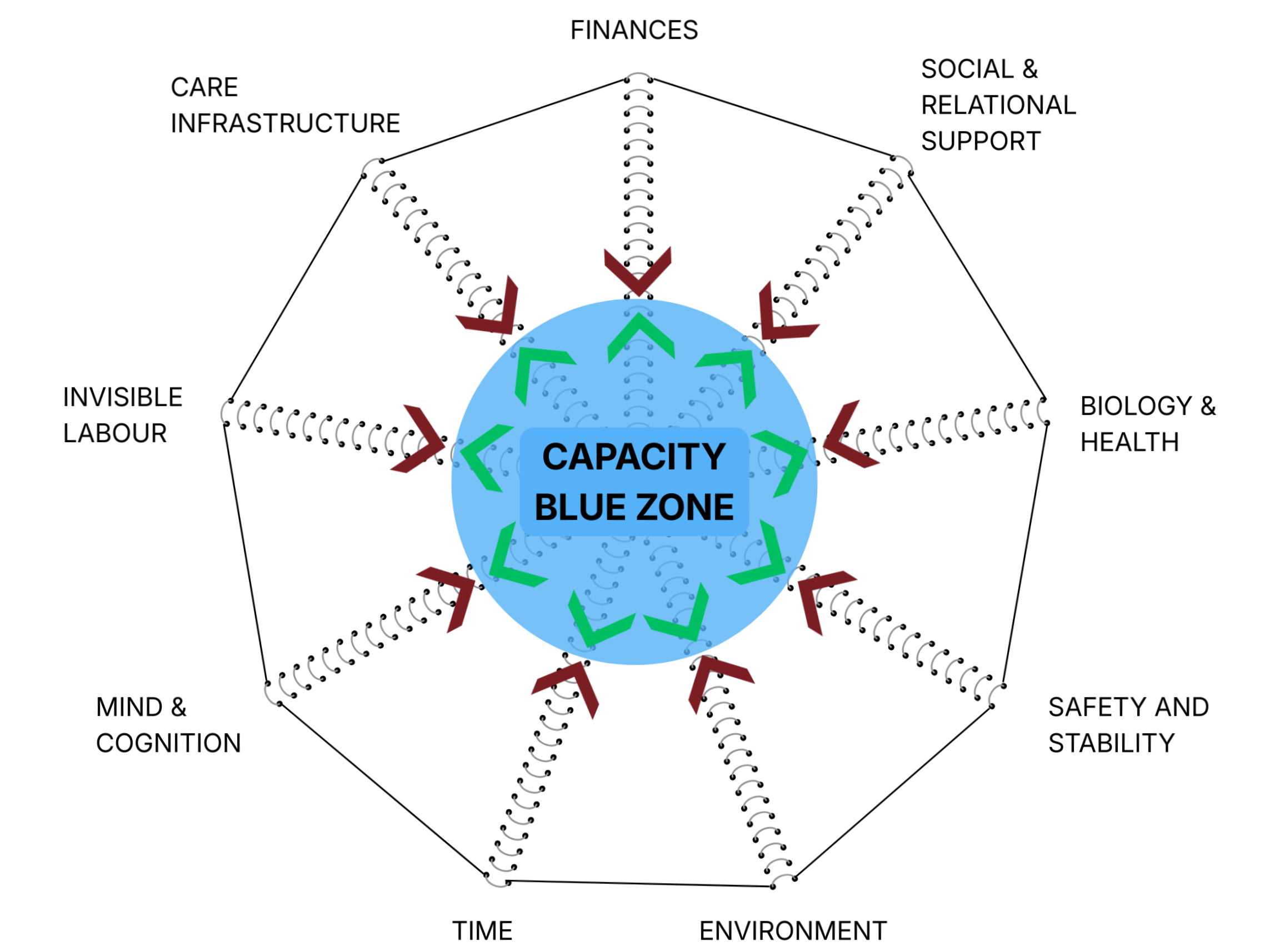
Figure 1: The Web of Capacity.
Visualised as a web, with the individual at the centre, these domains act as anchor points distributing tension across daily life. When conditions shift in one area, pressure redistributes across the rest of the system. Seen this way, balance rarely depends on one heroic change. There are often many small adjustments across the web that can restore stability.
Each thread and node contributes to where a person finds themselves within the structure.
The Capacity Nodes
The Architecture of Wellbeing identifies nine core capacity nodes. Together these nodes form the structural conditions that shape available capacity. Not isolated like pillars - these domains operate more like threads within a web. When tension changes in one part of the AoW system, pressure redistributes across the rest.
Conditions can vary widely throughout life. More money can buy time, or constrain it, depending on how it was earned and what responsibilities come with it. A supportive partner may stabilise several nodes at once, while sudden illness or caregiving can strain the entire structure. Within this system no single node controls the outcome, nor should it. The web is interactive and dynamic - both robust and sensitive to change.
Table 1 shows the capacity nodes and what each represents.
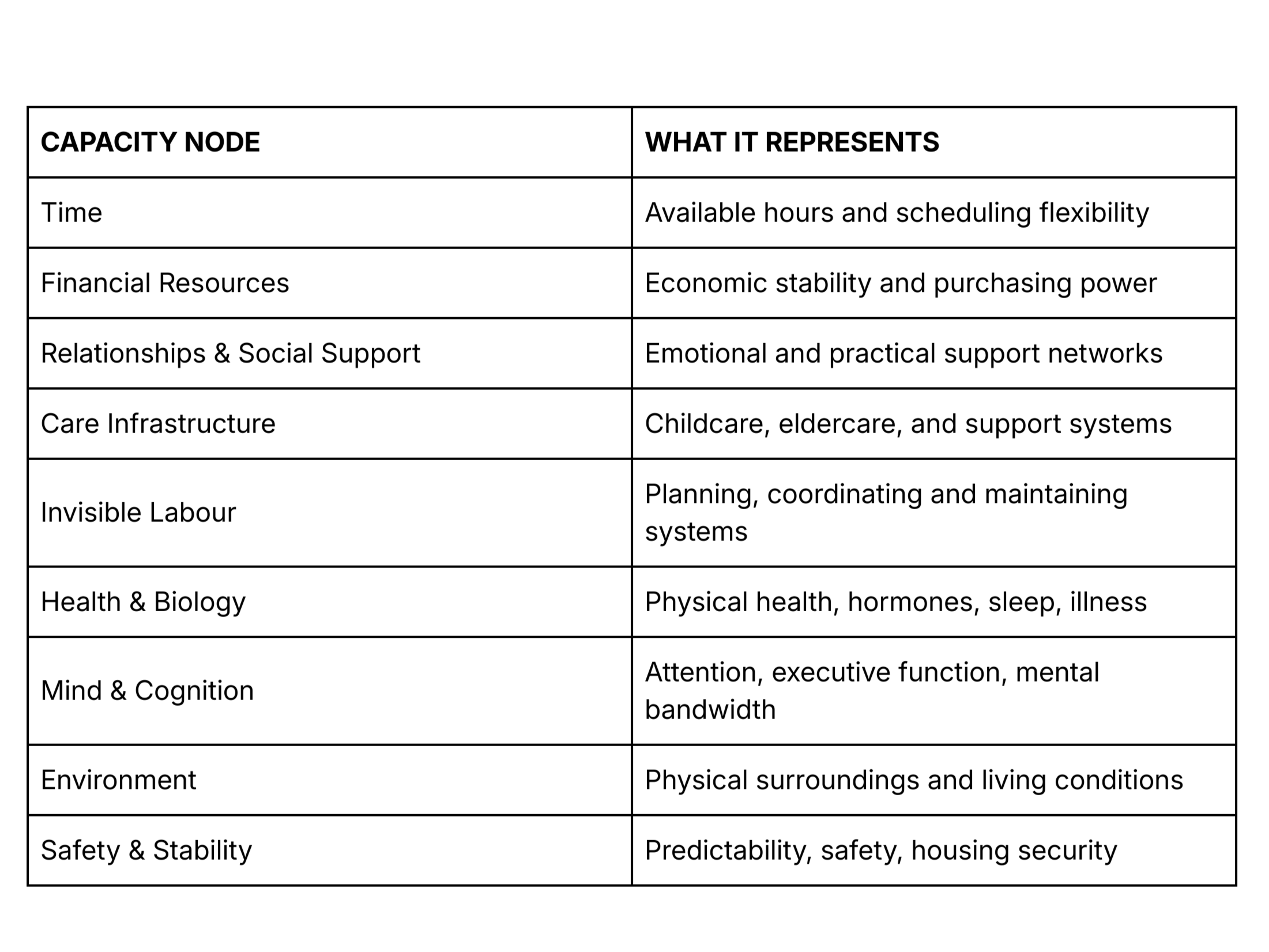
Table 1: The Capacity Nodes
Together these nodes describe the internal architecture of a capacity web. But no web exists in isolation. The conditions shaping each node are also influenced by wider forces operating across societies and communities - shaping how much capacity individuals and households are able to build in the first place.
Transverse Forces
I have always been interested in public health and the ways large systems shape the wellbeing of entire populations. The contrast between countries can be striking. In Finland, for example, every new parent receives a government-provided maternity package - commonly known as the Finnish "baby box" - containing essential items for a newborn and designed to support early child health and safety. Policies such as universal healthcare, parental leave and early childhood support systems can influence the wellbeing of millions of people at once.
At the other end of the spectrum, the absence of universal healthcare, or practices that directly harm bodily autonomy in some parts of the world, demonstrate how policy, culture and power structures can dramatically shape health outcomes.
These examples illustrate a simple point: wellbeing does not emerge only from individual behaviour. No web exists in isolation. The conditions shaping each node are influenced by wider forces still - operating across societies and communities, shaping how much capacity individuals and households are able to build in the first place.
These forces do not belong to any single node. They cut across the web itself, subtly changing the tension of multiple nodes at once. Below is a summary of some ways these forces interact with the nodes.
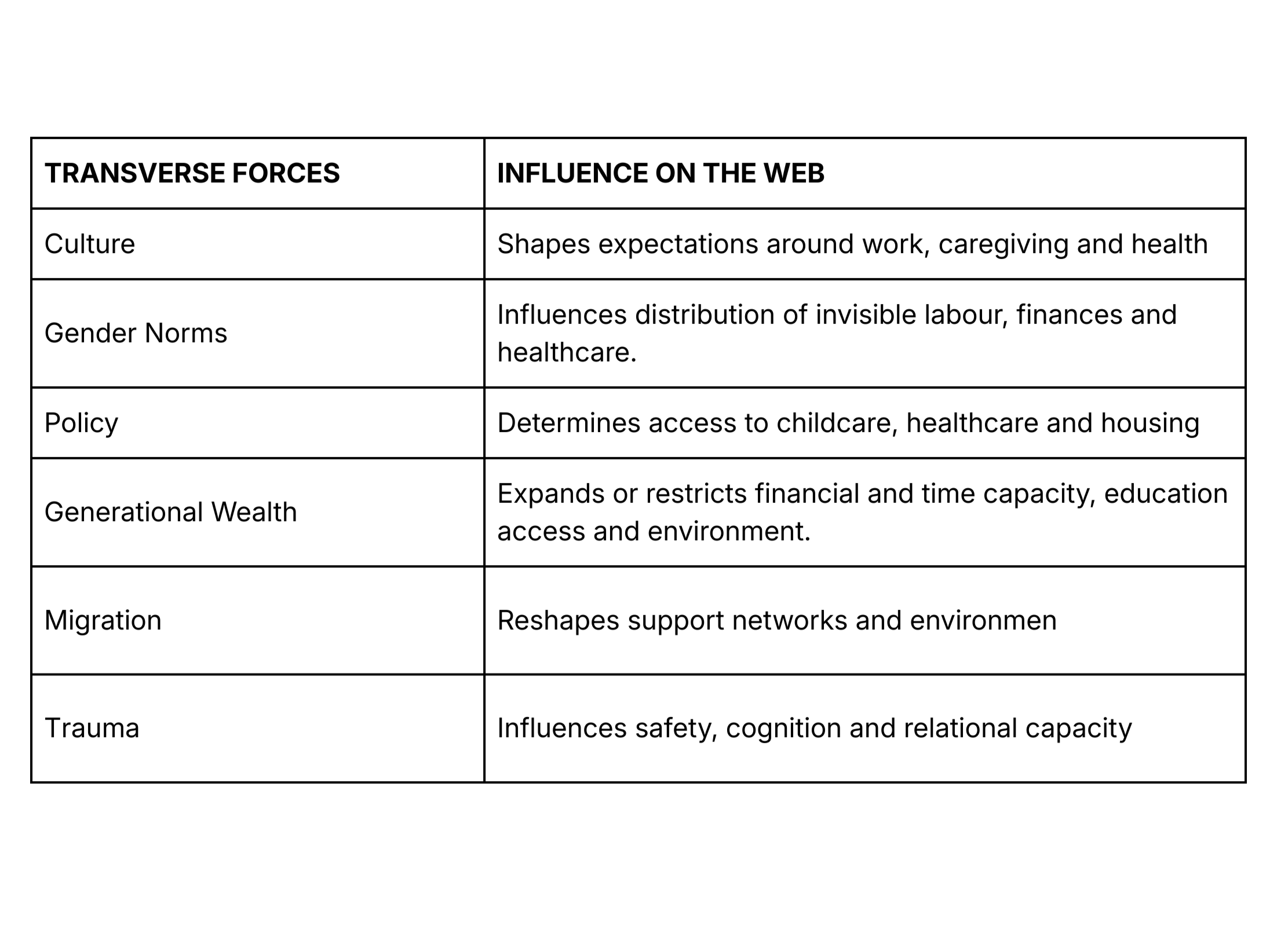
Table 2: Transverse Forces on the Web
You can change your habits. You cannot, alone, change your culture, your policy environment or the generational architecture you inherited. This is why the transverse forces matter.
Structural Principles of the Web
As nodes and transverse forces interact over time, patterns begin to appear in how systems stabilise, stretch or break down. Several structural principles became visible through this process - consistent enough across individuals, households and organisations to suggest they describe something real about the way capacity moves.
The Load Distribution Principle.
Systems remain stable when pressure can move across multiple nodes. They become fragile when load concentrates in one place — or around one person — for extended periods. Sustainable systems distribute stabilising responsibility rather than concentrating it.
The Elastic Capacity Principle.
Human systems are remarkably resilient, but their capacity is elastic rather than infinite. People can temporarily extend their available time, energy and emotional bandwidth to navigate demanding periods. New parents, caregivers and people managing crisis often operate in this extended state for months or even years. Eventually, elasticity has limits. When pressure accumulates across multiple nodes at once, the web weakens
The Behavioural Loop Principle.
Health behaviours function as both inputs and outputs within the system. A regular walk improves sleep, which improves cognitive bandwidth, which makes the next walk more likely. The reverse is equally true. Behaviours either reinforce the stability of the web or gradually destabilise it.
The System Scale Principle.
Capacity webs operate across individuals, households, workplaces and communities. The nodes look different at each level, but the underlying mechanics remain consistent. This is why the health of an ageing parent, or the income a partner contributes, ripples into the wellbeing of the wider system. The web does not disappear as systems grow. It simply becomes larger.
The Stabilisation Principle.
Systems tend to stabilise around individuals or nodes that repeatedly absorb pressure. These people function as system sentries — quietly monitoring tension and disproportionately called upon when pressure events arise. While this stabilising role can temporarily protect the system, prolonged concentration of load weakens the resilience of the web for everyone in it.
The Web at Different Scales
Although the AoW is easiest to picture at the level of an individual life, the same structural mechanics appear again and again at larger scales.
An overwhelmed parent, an overstretched business founder and a healthcare system in pandemic may appear to be entirely different problems. Viewed through the Architecture of Wellbeing, however, they reveal the same underlying mechanics of load distribution, capacity and stabilisation.
The web does not disappear as systems grow. It simply becomes larger.
Capacity Transfer
Because pressure redistributes across the web, strain rarely remains confined to one node or one person.
I think of this movement as capacity transfer. Within any web, when one node carries less load, the overall pressure does not disappear. Like energy, it shifts somewhere else. Time, money, caregiving, emotional labour and cognitive bandwidth constantly move through the structure seeking balance. The great Australian midweek dinner of a hot chook and a bag of coleslaw is one perfect example of that energy redistribution.
Energy cannot be created or destroyed - it can only be transferred. In a capacity web, the same is true.
Within households, this often appears as one person absorbing additional responsibility so another can recover from illness, pursue a career opportunity, or simply have an evening that belongs to them. Each time I head up Mt Lofty for a hike with friends, or my partner goes to Victoria Park for a run, the caregiving and invisible labour either piles up or transfers to someone else.
When capacity transfer is reliable and reciprocal, it expands what becomes possible in a week. Deferring tasks to squeeze more in usually doesn’t. The problems that never happened, the overwhelm that didn’t pile up. That’s capacity transfer at work.
Children require immense capacity transfer. The village surrounding a household is often the most stable and reciprocal source of it. When my niece had her netball final and the team agreed on matching braided hair, I received a single-breath text: “Auntie Jenny are you home I need you to braid my hair what time can you pick me up”.
I am the local fishtail-braid aficionado.
I was there in ten minutes.
When capacity transfer is visible and shared, systems can remain stable even during demanding periods. When it becomes chronically invisible or one-sided, pressure begins to concentrate around particular nodes and particular people. Negative feedback loops emerge. Over time, this can destabilise the web even when the surface of a life appears to be functioning smoothly.
People often believe they are observing discipline, motivation or personal failure, when what they are actually watching is the movement of capacity through a web.
From that misreading, a number of common fallacies in wellbeing thinking begin to take hold.
The Fallacies We Tell Ourselves
Several recurring simplified explanations appear when the Architecture of Wellbeing is not visible. These fallacies show up repeatedly in how wellbeing is commonly discussed - in health culture, in workplaces, and in the stories people tell about themselves.
The Discipline Fallacy.
The most common assumption in modern health culture is that successful people simply have more discipline. She gets up at 5am and trains before her family wakes up. He's been consistent for years. Must be discipline.
Within the Architecture of Wellbeing, discipline is an output. It reflects supportive infrastructure and available capacity as much as it reflects character. Stable systems allow habits to flourish. Strained systems make them fragile. This does not mean behaviour does not matter. It means behaviour does not occur in isolation.
The Individual Control Fallacy.
Wellbeing advice often assumes individuals have equal control over the conditions of their lives. In reality, many structural factors sit outside individual control: housing stability, policy environments, cultural expectations, family structure, caregiving responsibilities, economic conditions. Two people may attempt the same behavioural change while operating inside very different structural architectures. The outcomes will rarely be the same, and the difference is not character.
The Pillars in Isolation Fallacy.
Health conversations tend to focus on one factor at a time. Sleep. Nutrition. Exercise. Stress. While these domains matter enormously, treating them in isolation ignores the interconnected nature of the web. Pressure rarely remains confined to a single node. When a pillar falls — when the exercise routine collapses, the sleep deteriorates, the healthy eating disappears — that failure is rarely about the pillar itself. It is a symptom. The structural conditions surrounding it are under stress, and the pillar is simply the most visible thing to go. Even the gut health powder is a bandaid for the symptom.
The Visibility Fallacy.
Many of the most powerful influences on wellbeing remain invisible. Invisible labour, caregiving logistics, social support, environmental design and financial security quietly shape the capacity available to an individual or household. Because these forces operate in the background, attributing outcomes solely to personal choice becomes misleading. Capacity is often paid for by someone else. Once the web becomes visible, many of these assumptions begin to dissolve.
The Optimisation Fallacy.
Wellbeing discourse loves to optimise small behaviours while overlooking the far larger structural differences in conditions from person to person. Biohacks, supplements and productivity systems tend to target the final ten percent of potential improvement. Using the AoW framework, we see that most outcomes are shaped by the underlying ninety percent: time capacity, caregiving load, financial stability, social support, environment and structural safety. When the underlying architecture of a life is unstable, attempts to optimise small behaviours rarely produce lasting change. Structural stability matters more than marginal optimisation.
What State is Your Web In?
While many factors can influence the web, its overall condition at any given moment can usually be understood through four system states.
Capacity Stretch is gradual strain building across one or more nodes - insidious by nature. Think of a lobster in water that is slowly brought to the boil. The challenge is not the temperature at any single moment. It is the longevity of it. Long working hours, chronic sleep deprivation, caregiving load, or the quiet accumulation of invisible labour can slowly tighten the web over months or years. Depletion without sufficient recovery. Pressure builds and is often normalised. Change is considered long after the structure is already under serious strain. Many people do not realise they have been in a capacity stretch until something small and seemingly manageable finally breaks them.
Capacity Shock is survivable when other nodes are stable enough to absorb it. I once moved house alone with two small children while my husband was away for work. At the time I had a second degree burn that was infected on my arm, rubbing right where the boxes would hit as I carried and stacked them. I was only moving 2 streets away and could carry a washing machine the length of a hallway. I could not carry that washing machine for a year, which is the difference between a capacity shock and a capacity stretch. Shocks are common in everyday life. Most of us move through several a year without naming them as such.
Capacity Earthquake is different. Earthquakes occur when several major pressures arrive at once, or when one life event destabilises multiple nodes simultaneously. The arrival of a new baby, relationship breakdown, bereavement, major illness - these rarely affect just one part of life. They send shockwaves through the entire structure, impacting finances, time, emotional capacity, relationships and physical health all at once. The web must stretch dramatically to absorb the impact, and sometimes nodes detatch, temporarily collapse and must be rebuilt. Many people recognise these seasons immediately. The question is no longer about optimisation. It is about survival. Rest assured though: repair is possible.
Capacity Blue Zone describes a state of relative equilibrium - the gold standard. When supportive conditions align, wellbeing becomes the path of least resistance rather than another task forced into an already crowded life. The web holds its shape with far less effort, adapting with resilience to the flexion and change of a life well lived. This is where the street nonna lives. The one who has never done a Pilates class in her life and is absolutely fine.
Seeing the Web: Toward a Diagnostic Tool
If wellbeing emerges from the architecture of daily life, understanding it requires looking beyond symptoms toward structure.
One of the most significant practical extensions of the AoW framework is a diagnostic tool designed to map the nine capacity nodes across an individual's web. Rather than evaluating personal discipline or behavioural success, this kind of assessment would identify where structural pressure is concentrated — and where recalibration would relieve it most.
Visualising how load is distributed across the system shifts the conversation from "Why can't I keep up?" to "Where is the system carrying too much weight?"
The applications are broader than the individual. The same diagnostic logic applies to couples and households -mapping where capacity transfer is invisible or chronically uneven, and what redistribution might actually look like in practice. It applies to clinical settings, where a practitioner working with burnout, anxiety or chronic illness might use the web to identify structural contributors that sit well outside their typical scope, but are nonetheless driving the presenting condition. It applies to workplaces, where team leaders or HR practitioners could use the framework to identify structural bottlenecks — the system sentries quietly absorbing disproportionate load, the nodes under pressure that no productivity intervention will fix.
In each of these contexts, the purpose is not to produce a score of success or failure. It is to make the invisible visible. To provide a map of a system's current structural position - where the web is stable, where it is stretched, and where recalibration is most likely to produce lasting change.
Over time, a validated assessment tool of this kind could allow researchers to examine patterns of structural wellbeing at scale, in much the same way that psychology currently measures burnout, stress or cognitive load. The individual web, it turns out, has much to tell us about the systems surrounding it.
Once the web becomes visible, many of the stories we tell about discipline, success and failure begin to change.
The Architecture of Wellbeing does not remove the role of personal choice. It simply reveals the structure within which those choices are made. When that structure is stable, healthy behaviours become easier to sustain. When it is strained, survival itself can become the achievement.
Looking back, I can see that the framework only became visible to me because my own web changed. Some nodes weakened dramatically while others strengthened in ways I hadn't expected. That instability made the structure visible. What I had assumed was personal failure began to look more like structural strain.
Once the threads were visible, they could no longer be unseen.